
Housing industry insights
Advocacy & policy
News & inspiration
Support & guidance
Member perks
Industry insurance
For your business
Apprentices
Building it right
Managing your business
Managing your safety
Building your business
Other subjects
A rewarding career
Study with us
A job in the industry
Grow with us
Our podcasts
Our initiatives
Get involved
Awards
Awards winners
Industry events
Most popular products
Top categories
For your business
{{propApi.title}}
{{propApi.text}} {{region}} Change location{{propApi.title}}
{{propApi.successMessage}} {{region}} Change location {{propApi.title}}
{{propApi.text}} {{region}} Change location{{propApi.title}}
{{propApi.successMessage}} {{region}} Change locationConstruction loans remain elevated in August
Construction loans remain elevated in August
Member and guest login
Enter your email and password to access secured content, members only resources and discount prices.
Did you become a member online? If not, you will need to activate your account to login.
If you are having problems logging in, please call HIA helpdesk on 1300 650 620 during business hours.
Forgotten password
Need some help?
If you are having problems logging in, please call HIA helpdesk on 1300 650 620 during business hours.
If the email address you have entered is registered, you will receive an email with further instructions.
Become part of the HIA community
Enables quick and easy registration for future events or learning and grants access to expert advice and valuable resources.
Create a guest account
Enter your details below and create a login
Send me exclusive tips, early access to new launches, and special offers. I can change my mind at any time.
By clicking Get started now you agree to the terms and conditions and privacy policy.
“The number of loans for the construction of a new dwelling fell by 4.9 per cent in August but remains elevated compared to pre-COVID levels,” stated HIA Economist, Tom Devitt.
The ABS released the Lending to Households and Businesses data for August 2021 today. The publication presents statistics on housing finance commitments including for the purchase or construction of new dwellings.
“The number of loans for the construction of new homes has continued its decline since the end of HomeBuilder in March,” added Mr Devitt.
“Despite these declines, the number of loans still remains up by 51.0 per cent in the three months to August 2021 compared to the same period two years ago.
“This will ensure a solid pipeline of home building work and associated employment well into the second half of 2022.
“First home buyer activity has also remained elevated and they now account for 35 per cent of the market. This remains above the average of the last decade as they take advantage of record low interest rates.
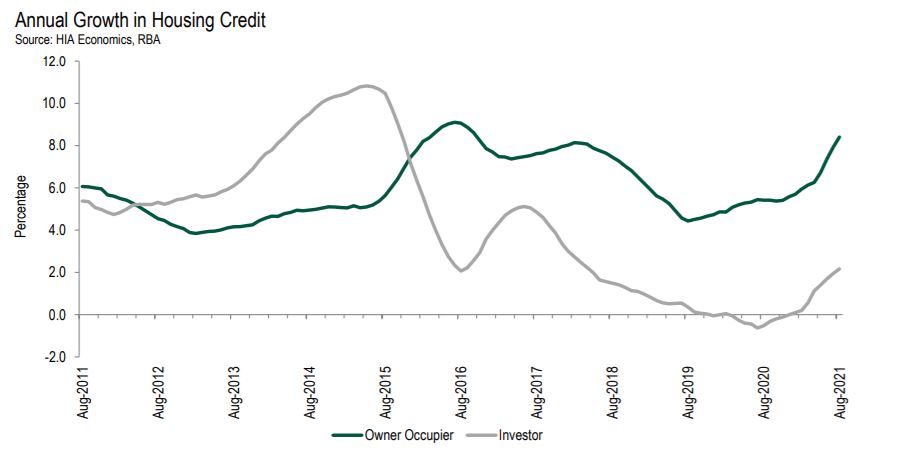
“Investor activity is also returning to long term trends with lending to investors rising by 1.5 per cent in August. Investors now account for almost one-third of the value of loans issued. This remains well below the peaks seen pre-COVID when macro-prudential restrictions were introduced.
“Lending for home renovations however, remains exceptionally high. The value of loans issued for renovations in the past three months is 122.7 per cent higher than the same period last year. This has been driven by record household savings and structural shifts as we spend more time at home,” concluded Mr Devitt.
Across the states, the number of loans to owner-occupiers for the construction of a new dwelling in the three months to August 2021 compared to the same time last year has increased in almost all jurisdictions:
- South Australia by +69.6 per cent
- The Australian Capital Territory by +61.3 per cent
- Western Australia by +48.0 per cent
- Tasmania by +44.2 per cent
- New South Wales by +27.8 per cent
- Victoria by +27.5 per cent
- Queensland by +20.0 per cent
- The Northern Territory is down by 48.0 per cent.
For further information please contact:
Tom Devitt, Economist 0439 514 656
Tim Reardon, Chief Economist 0423 141 031
Tasmanian Government adopts new Amended AS 4000 Contract
Following a Tasmanian government review, builders who deliver government civil and housing projects should be aware that the Amended AS 4000 contract has now been approved for these types of building works.
Housing slowdown puts billions in state revenue at risk
“Australia’s growing reliance on stamp duty revenue has been exposed again, with a slowing housing market expected to wipe billions of dollars from state government budgets,” stated HIA Senior Economist Tom Devitt.
Understanding asbestos risks remains critical for Australia's ageing building stock
National Asbestos Awareness Week is a timely reminder that while Australia has made significant progress in managing asbestos risks, awareness and education remain important given the age of the nation's housing stock and the continued popularity of home renovations and improvements, according to HIA Managing Director Jocelyn Martin.
Industry leaders unite in calling action on building research, testing and certification
Senior building industry leaders, researchers, manufacturers, universities, standards bodies and testing and certification experts met in Canberra today to call for urgent national action to strengthen Australia's building research, testing and certification capability, warning that critical expertise, facilities and technical capability could be lost without stronger national coordination and long-term planning.